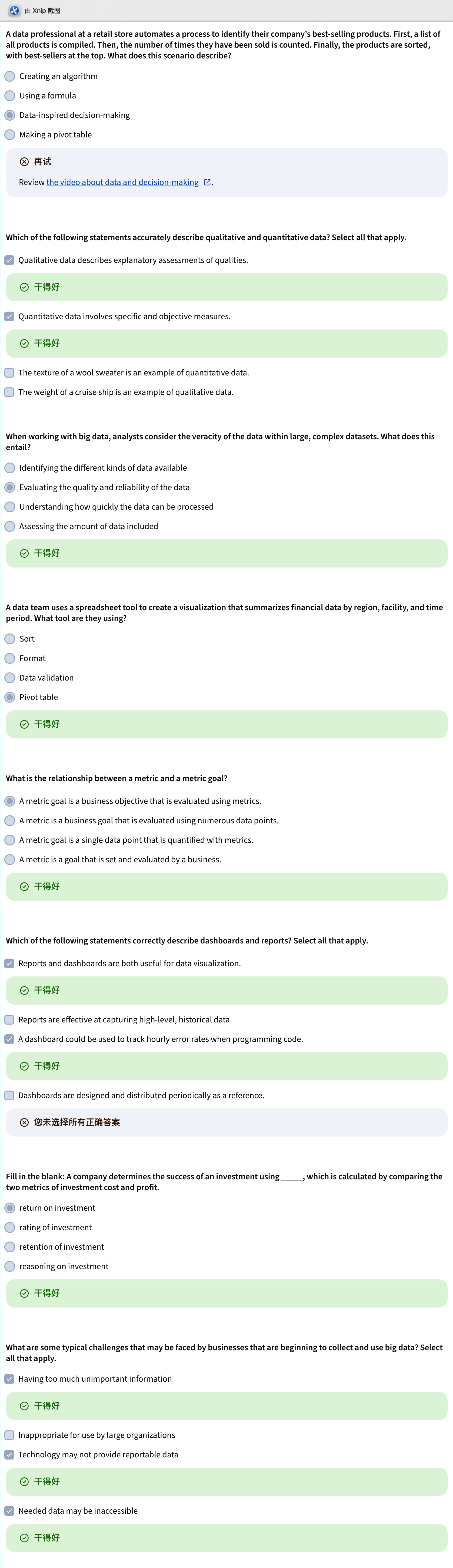
Challenge 2
Terms and definitions for Course 2, Module 2 Algorithm: A process or set of rules followed for a specific task
Big data: Large, complex datasets typically involve long periods of time, which enable data analysts to address far-reaching business problems
Dashboard: A tool that monitors live, incoming data
Data-inspired decision-making: The process of exploring different data sources to find out what they have in common
Metric: A single, quantifiable type of data that is used for measurement
Metric goal: A measurable goal set by a company and evaluated using metrics
Pivot chart: A chart created from the fields in a pivot table
Pivot table: A data summarization tool used to sort, reorganize, group, count, total, or average data
Problem types: The various problems that data analysts encounter, including categorizing things, discovering connections, finding patterns, identifying themes, making predictions, and spotting something unusual
Qualitative data: A subjective and explanatory measure of a quality or characteristic
Quantitative data: A specific and objective measure, such as a number, quantity, or range
Report: A static collection of data periodically given to stakeholders
Return on investment (ROI): A formula that uses the metrics of investment and profit to evaluate the success of an investment
Revenue: The total amount of income generated by the sale of goods or services
Small data: Small, specific data points typically involving a short period of time, which are useful for making day-to-day decisions